

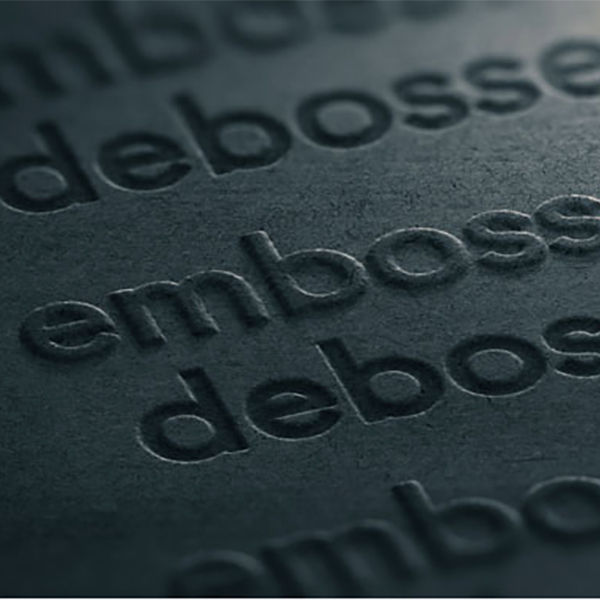
At a glance, debossing and embossing may look like stylistic alternatives. But in Dubai and across the UAE, where finish and detail often reflect seniority and intent, the choice between the two can shape how your gift is perceived.
For that reason, it calls for a much closer examination if you want your branding to land as intended.
In this guide, we’ll explain in detail each of the two print finishing techniques and how they influence perception. We’ve also provided a quick, practical framework to help you choose the finish that truly elevates your corporate gifts.
What’s the Difference Between Debossing and Embossing?
The difference between debossing and embossing comes down to direction and depth. Embossing raises your logo or design outward from the surface, while debossing presses it inward to create a recessed impression.
Both use metal dies and pressure, but the visual and psychological effect they create is very different.
Let’s unpack the differences further by zooming in on each technique.
What is debossing?
Debossing is a print finishing technique that creates a recessed logo, text or design pressed inward into a material. Instead of raising the surface, the design is stamped downward so it sits below the surface level.
Visually, a debossed design looks like an imprint carved into the material, something you’ll often see on leather planners and executive folders.
Here’s how the debossing technique works in production:
- A custom metal die is created based on your logo or artwork.
- The material is positioned beneath the die.
- Heat and pressure are applied.
- The die presses the design downward into the surface.
- The material compresses and retains the recessed impression once cooled.
The resulting design is generally one that doesn’t cry for attention. Instead, it’s something that invites a closer look. Calm and subtle.
What is debossing used for?
Typically, debossing is used to create recessed brand markings on executive leather gifts, luxury corporate gift sets, premium journals and VIP appreciation gifts. That’s largely due to its ability to convey refinement, exclusivity, personalisation and prestige.
To give you an example, below are corporate gifts with embossed elements Wrapp Up offers:
- Oku: Card holder with debossed logo
- Qmat: Dual-function mousepad with a removable 10W wireless charging pad
- Keopi: Eco-journal with a debossed emblem on the back cover
- Cross notebook: Premium black matte notebook accented with a subtle debossed logo
Is debossing permanent?
Yes, debossing is generally permanent because it physically compresses the material rather than applying ink. As long as the substrate is dense enough, such as on leather and thick boards, the recessed impression remains intact over time, even with regular handling.
What is embossing?
Embossing is a print finishing technique used to create raised logos or designs that sit above the surface of the material. Instead of printing ink on top, a custom metal die presses the material upward using heat and pressure, forming a three-dimensional effect that you can both see and feel.
Practically speaking, this technique is responsible for that popping 3D effect typical of business card logos and brand names on rigid, matte-finish packaging boards.
On leather folders or presentation boxes, it casts a subtle shadow around the edges, adding depth and making the logo feel raised and tactile.
Here’s how the embossing technique works in production:
- A custom metal die is created based on your logo or artwork.
- A matching counter-die is prepared to support the material from the opposite side.
- The material is placed between the two dies.
- Heat and pressure are applied, pushing the design upward.
- The surface forms a raised impression that retains its new shape once cooled.
That combination of visual prominence and tactile engagement is what makes embossing highly effective for premium packaging, event presentation boxes, branded folders and client-facing kits where visibility matters.
Some of Wrapp Up’s offerings that feature an embossed design include:
- Woven Towel: Europe-made, 100% cotton jacquard towels with embossed logo
- Elysia: Metal USB stick with key ring and embossing on leather cover
Does embossing fade?
Embossing does not fade in the way ink does, but it can flatten over time if the material is too soft or frequently handled. On rigid paper boards and structured packaging, embossing holds its shape well. All that’s to say the raised effect depends on material thickness and density.
Debossing vs embossing: Side-by-side comparison
Here’s a closer look at how debossing and embossing compare across key areas.
- Surface effect: Embossing raises the design above the surface. Debossing presses it below the surface.
- Visual presence: Embossing creates shadow and height that catch light. Debossing creates a deep, carved effect.
- Branding style: Generally speaking, embossing suits marketing-driven campaigns and high-visibility event gifts. Debossing aligns with executive, luxury and prestige positioning.
- Production & cost: Both techniques require custom metal dies and setup fees. Individually, embossing may require thicker substrates, while debossing depends on material density to hold depth cleanly, which can also affect unit pricing. In both cases, complex logos increase tooling costs.
- Durability: Debossing holds well on dense materials like leather. Embossing can flatten on softer stocks if the material thickness is insufficient.
- Material compatibility: Embossing performs best on rigid paper boards and structured packaging. Debossing excels on leather, faux leather and premium journal covers.
Why Knowing the Difference Between Debossing and Embossing Matters for Corporate Gifting
The psychology of texture in branding
Touch influences how people feel about a product before they consciously analyse it. Research published in the International Journal of Design backs this up.
It shows that tactile input shapes not only how people learn about a product, but also their immediate emotional response to it. Emotional reactions such as desire, satisfaction and overall liking were influenced more by a product’s sensory characteristics than by external cues alone.
With that said, a raised or recessed logo resulting from either embossing or debossing techniques doesn’t just change appearance, nor is it simply decorative in function. It invites touch – a sensory interaction – that can elevate how the gift and the brand behind it are perceived.
Brand positioning and perception in the UAE market
In Dubai and across the UAE, there’s a strong culture of subtle luxury, where hierarchy and prestige are often communicated through details rather than loud displays. That means you can’t choose branding finishes at random. You have to think strategically about how embossing or debossing fits the positioning you’re trying to convey.
We’ll get into the specifics of when to choose each technique later on, but as a general rule of thumb:
- Executive settings and VIP gifts tend to favour debossing for its understated, refined feel.
- Large-scale events, exhibitions and promotional campaigns tend to favour embossing for stronger visual impact and brand visibility.
When to Choose Embossing for Corporate Gifts
Embossing works best when visibility and brand presence are the priority. If the goal is to make your logo stand out immediately, especially in crowded or competitive environments, a raised finish delivers that visual lift.
Best applications and ideal gift categories
Embossing is particularly effective in scenarios where first impressions and brand recall matter most:
- Trade show giveaways and event gifts such as premium notebooks and folders that need to stand out on busy exhibition tables
- Event packaging and presentation boxes where the raised logo adds dimension under venue lighting
- Client appreciation kits designed for broader distribution rather than ultra-exclusive recipients
- Limited-edition promotional merchandise tied to marketing campaigns or product launches
In each of these cases, the raised surface helps your brand catch light, attention, and memory.
Things to consider before choosing embossing
Before finalising embossing as your branding technique, production realities should guide the decision:
- Material thickness: If you’re working with thicker paper stocks or rigid boards, embossing will hold its shape well. On thinner materials, however, the raised effect can distort or look uneven.
- Backside impression risk: On lighter stocks, the raised design may show through on the reverse side. If both sides of the piece matter visually, this is something to check early.
- Die complexity and cost: Intricate logos or very fine details increase tooling costs and may lose sharpness at smaller sizes. Simpler designs usually translate more cleanly.
- Lead times: Embossing requires custom dies and sample approvals. If your event date is tight, especially in Dubai and across the UAE where schedules can compress quickly, you’ll need to plan ahead.
When to Choose Debossing for Corporate Gifts
Debossing works best when prestige, hierarchy and long-term relationship building are the priority, as a recessed finish excellently delivers that controlled, executive feel.
Best applications and ideal gift categories
Debossing is particularly effective in high-trust, high-value contexts where discretion matters more than exposure:
- Executive leather gifts such as planners, portfolios, card holders and desk pads where the recessed mark reinforces authority
- Luxury corporate gift sets packaged in rigid boxes or wrapped in textured materials where subtle branding increases perceived exclusivity
- Employee milestone and recognition gifts that need to feel earned rather than promotional
- VIP and stakeholder appreciation pieces designed for board members, C-suite leaders and long-term partners
- High-end employee welcome kits for senior hires
Things to consider before choosing debossing
Before finalising debossing as your branding technique, make sure the decision aligns with both design and production realities:
- Logo simplicity: If your mark is clean and bold, debossing will translate beautifully. Fine lines or intricate details, however, can lose clarity once pressed into the surface.
- Material density: Leather and thick boards hold depth more consistently. If you’re working with softer or uneven materials, the impression may come out lighter or inconsistent.
- Brand confidence: Debossing is subtle by nature. Your branding should still be recognisable without relying on strong contrast or colour to stand out.
- Material quality: Because debossing creates a recessed finish, it can highlight imperfections in the material. Higher-quality materials make a noticeable difference in the final look.
- Campaign objective: If your goal is broad visibility and quick recognition rather than prestige positioning, embossing may better support that outcome.
What Materials Work Best With Each Print Finishing Technique
Leather and faux leather
Debossing performs exceptionally well on leather because the material compresses cleanly and retains depth over time. The recessed effect looks intentional and refined, especially on executive planners, portfolios and desk accessories.
Embossing can work on thicker, structured leather. However, if the leather is too soft, the raised effect may flatten with use.
Paper and packaging boards
Embossing works best on rigid paper stocks and thick packaging boards. Event boxes, presentation folders, and high-visibility kits benefit from the raised finish, especially under venue lighting.
Debossing works well for premium stationery and invitation-style materials where subtlety is preferred.
Always remember: thickness matters. If the stock is too thin, both techniques can show through on the reverse side.
Fabric and other surfaces
Embossing and debossing are not suitable for most fabrics. Materials such as cotton, canvas and polyester lack the density required to retain a pressed impression.
For fabric-based corporate gifts like tote bags or apparel, consider using alternative branding methods, such as:
- Screen printing for bold, cost-effective visibility.
- Embroidery for texture and durability.
- Heat transfer for detailed, full-colour logos.
How to Decide Between Debossing and Embossing
Start with these 5 questions
Before approving artwork or production, pressure-test the decision against these fundamentals:
- Who is receiving the gift?
- Executives and VIPs: Deboss.
- Event attendees and mass distribution: Emboss.
- What is the primary objective?
- Prestige and relationship depth: Deboss
- Visibility and recall: Emboss.
- What tone should the gift convey?
- Restrained authority: Deboss.
- Bold brand presence: Emboss.
- What material are you using?
- Leather and dense boards: Deboss.
- Rigid paper boards and structured packaging: Emboss.
- What budget tier applies?
- Premium, smaller-quantity gifting: Deboss.
- Larger-scale, exposure-focused campaigns: Emboss.
Take note that these rules aren’t absolute. But it’s a good starting point to help prevent early misalignments between technique and positioning that, if overlooked, can snowball into bigger problems later on.
Common mistakes to avoid when choosing
Many branding errors happen not in production, but in decision logic. Avoid these common pitfalls:
- Blindly copying competitors: Choosing a finish just because others are using it, not because it actually suits your brand.
- Not having a concrete direction: Using embossing in one campaign and debossing in another with no clear reason.
- Using overly detailed logos: Choosing designs with thin lines or tiny text that won’t show clearly once pressed or raised.
- Leaving it entirely to the supplier: Treating the finish as a technical detail instead of deciding how you want your brand to come across.
Still Not Sure Which to Choose Between Debossing and Embossing?
So far, we’ve covered how debossing and embossing each have their place in corporate gifting, and how the right choice comes down to your audience, campaign objective, and material. We’ve also outlined a practical framework to help you decide which finish fits best.
If you’re still unsure or simply don’t know where to start, feel free to reach out. Wrapp Up is an end-to-end corporate gifting partner, from concept and sourcing to branding and delivery across Dubai and the UAE. Book a call today!
FAQs
Can you combine debossing or embossing with foil stamping?
Yes, you can combine both debossing or embossing with foil stamping. The foil adds color and reflectivity, while the pressed effect adds depth.
Emboss + foil creates a high-visibility, premium look suited for VIP boxes and presentation packaging. Deboss + foil produces a more refined, luxury effect often used on executive leather goods and upscale gift sets.Is debossing the same as embossing?
No, debossing is not the same as embossing. Embossing raises the design above the surface, while debossing presses it into the material. Both use metal dies and pressure, but they create opposite surface effects and communicate different brand signals.
Is embossing considered luxury printing?
Yes, embossing can be considered a luxury finish, especially on thick paper stocks and premium packaging. When executed on quality materials, embossing can enhance perceived value.
However, note that luxury perception varies from person to person and is not solely based on the technique alone. So, we can argue that an embossed finish can also work for trade show giveaways and promotional gifts in Dubai.Is debossing better than embossing?
Debossing is not inherently better than embossing. The better choice depends on your objective and audience. For executive, prestige-driven gifts, debossing often aligns better. For visibility-focused campaigns and events, embossing may be the stronger option.
Does Wrapp Up offer debossed or embossed printing for corporate gifts?
Yes, Wrapp Up offers both debossing and embossing for corporate gifts across Dubai and the UAE. But beyond simply serving as suppliers, we’re also your strategic partners, guiding you on which print finishing technique aligns with your audience, material and campaign objective.
Leave a Comment
Your email address will not be published. Required fields are marked *